In Planung: PQMex® – Cast für Flachfolien und PET
Bislang prüft der PQMex® Rezyklat an Blasfolie. Viele Verarbeiter produzieren jedoch auf Cast-Linien – zum Beispiel Stretch- und Wickelfolien oder Verpackungsfolien. Für sie planen wir den PQMex® – Cast. Noch ist das Projekt ein Konzept; die Umsetzung ist voraussichtlich für das kommende Jahr vorgesehen.
Prüfen wie in der eigenen Produktion
Beim PQMex® – Cast tritt die Schmelze aus einer Breitschlitzdüse aus und wird auf einer Kühlwalze zur Flachfolie abgekühlt. Das Material wird damit unter Bedingungen geprüft, die dem späteren Verarbeitungsverfahren entsprechen. Gele, Fischaugen und Verunreinigungen sollen erkannt werden, bevor eine Charge auf die Cast-Linie gelangt – dort führen sie zu sichtbaren Fehlstellen oder Bahnabrissen.
Auch für PET
Anders als der heutige PQMex®, der PE an Blasfolie prüft, soll der PQMex® – Cast auch PET (Polyethylenterephthalat) verarbeiten können – etwa rPET aus dem Flaschen- und Schalenrecycling, das häufig zu Flachfolien und Platten weiterverarbeitet wird. Damit lässt sich erstmals auch PET-Rezyklat mit der Prüftechnik des PQMex® bewerten. Da PET Feuchtigkeit aufnimmt, muss es vor der Extrusion getrocknet werden; wie die Materialvorbereitung gelöst wird, ist Teil der weiteren Konzeptarbeit.
Aufgebaut wie der PQMex®
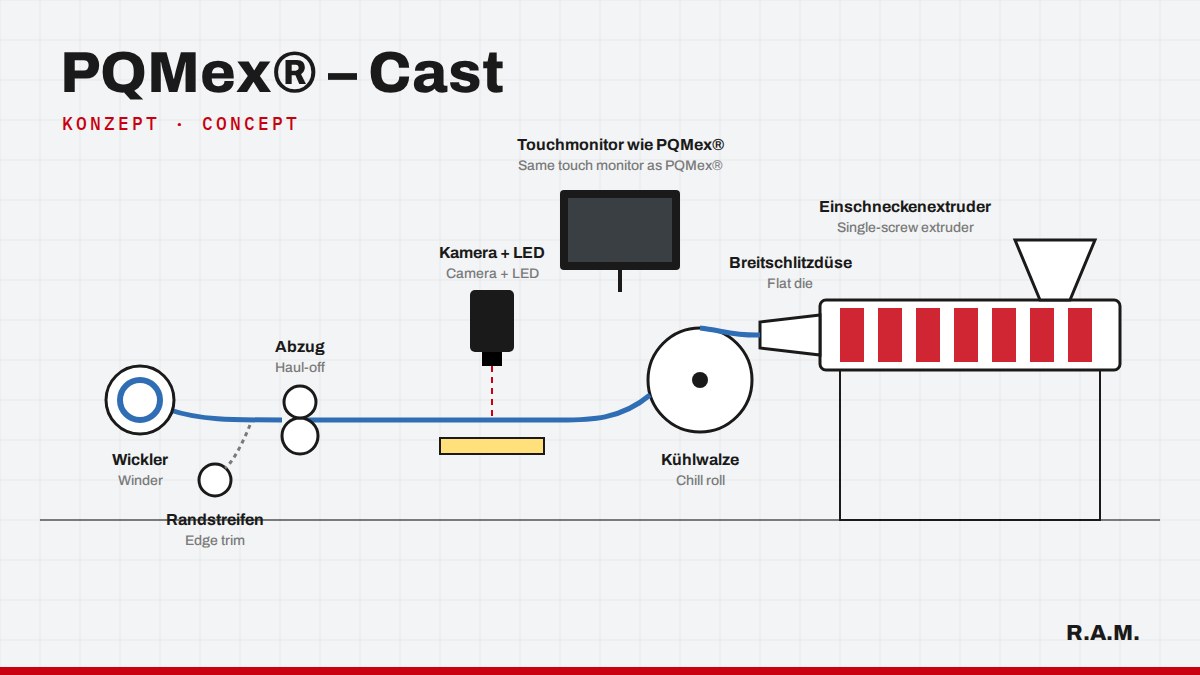
Grundlage ist eine Cast-Laboranlage, die wir nach dem Vorbild des PQMex® umbauen: Einschneckenextruder, Breitschlitzdüse und Kühlwalze, dahinter Kamera und LED-Beleuchtung, Abzug, Wickler und die Aufwicklung der Randstreifen. Bedienung und Ausstattung übernehmen wir vom PQMex® – der Touchmonitor ist beispielsweise derselbe.
Bewährte Prüftechnik
Die Auswertung entspricht der des PQMex®: CAMEN erkennt und klassifiziert die Fehler, das Material wird in Güteklassen eingeteilt, und die Ergebnisse stehen in vSTAT zur Verfügung.
Sie verarbeiten Rezyklat – auch rPET – auf Cast-Linien? Sprechen Sie uns an – Ihre Anforderungen fließen gern in die Entwicklung ein.
So far, the PQMex® tests recyclate using blown film. Many processors, however, produce on cast lines – for example stretch and wrap films or packaging films. For them, we are planning the PQMex® – Cast. The project is still a concept; implementation is expected next year.
Testing as in your own production
With the PQMex® – Cast, the melt leaves a flat die and is cooled on a chill roll to form a flat film. The material is thus tested under conditions that correspond to the later processing method. Gels, fisheyes and contamination are to be detected before a batch reaches the cast line – where they cause visible defects or web breaks.
Also for PET
Unlike today’s PQMex®, which tests PE using blown film, the PQMex® – Cast is intended to process PET (polyethylene terephthalate) as well – for example rPET from bottle and tray recycling, which is often processed into flat film and sheet. This will make it possible to assess PET recyclate with PQMex® inspection technology for the first time. As PET absorbs moisture, it must be dried before extrusion; how material preparation will be handled is part of the further concept work.
Built like the PQMex®
The basis is a cast laboratory line that we are rebuilding along the lines of the PQMex®: single-screw extruder, flat die and chill roll, followed by camera and LED lighting, haul-off, winder and edge-trim winding. Operation and equipment are taken over from the PQMex® – the touch monitor, for example, is the same.
Proven inspection technology
The evaluation is the same as on the PQMex®: CAMEN detects and classifies the defects, the material is assigned to quality grades, and the results are available in vSTAT.
Do you process recyclate – including rPET – on cast lines? Get in touch – we are happy to take your requirements into account in the development.
Fragen zu einer Meldung?
Sprechen Sie mit uns über unsere Systeme, Projekte und Messeauftritte – wir melden uns schnell zurück.